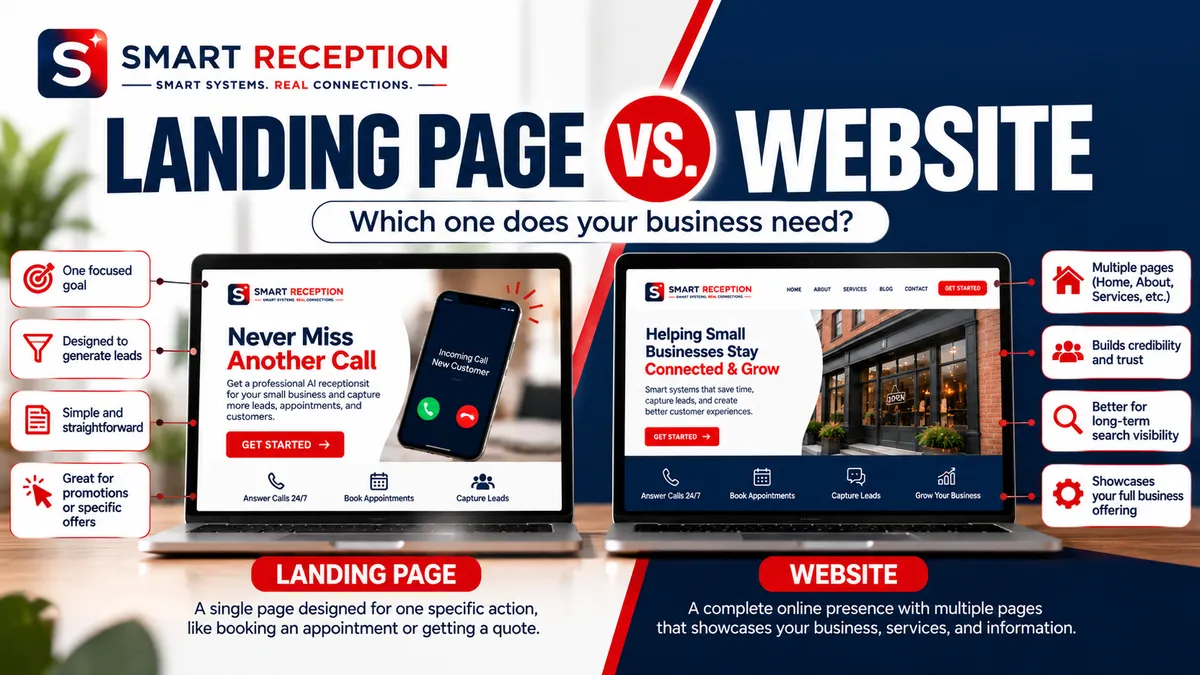
Landing Page vs. Website: What’s the Difference?
Web Design, Small Business Marketing, Smart Reception
Landing Page vs. Full Website: What Small Businesses in the Mid-Ohio Valley Really Need
If you run a small business in Parkersburg, Vienna, or anywhere in the Mid-Ohio Valley, you know you need to “be online.” But should you start with a simple landing page, invest in a full website, or use both? Understanding the difference can save you money, focus your marketing, and help you turn more visitors into real customers.
What Is a Full Business Website?
A full business website is your company’s complete home base online. It usually includes multiple pages that work together to tell your story, explain your services, and make it easy for people to contact you and trust you. For a local business, this often means pages like:
Home: A big-picture overview of who you are and what you do in the Mid-Ohio Valley.
Services: Detailed descriptions of what you offer, often with separate pages for each main service (for example, “Brake Repair,” “Oil Changes,” or “Family Law”).
About: Your story, team, and local roots in Parkersburg, Vienna, or the surrounding area—key for building credibility and trust.
Contact: Phone, email, address, hours, and often a contact form or online booking link.
Optional extras like a blog, FAQ, or testimonials to support long-term marketing and search visibility.
A well-built website gives you a complete online presence. It’s where people go when they Google your business name, search for “plumber near Parkersburg,” or click your business listing on Google Maps. It helps you show up in search results, answer questions, and prove you’re a real, professional operation—not just a phone number on a flyer.
What Is a Landing Page?
A landing page is different. Instead of being your whole online home, it’s a single focused page built around one specific goal or campaign. Everything on the page is designed to push visitors toward that one action, such as:
Filling out a form to request a quote or book an appointment.
Claiming a special offer (for example, “$49 New Patient Exam in Vienna” or “Free AC Check in Parkersburg”).
Registering for an event, workshop, or seasonal promotion.
Joining your email or SMS list to get updates or coupons.
A landing page usually has fewer links and distractions than a full website. You’ll see a clear headline, a short explanation, maybe a few testimonials, and a strong call-to-action button like “Schedule Now” or “Get My Coupon.” It’s built to convert visitors into leads or customers as efficiently as possible.
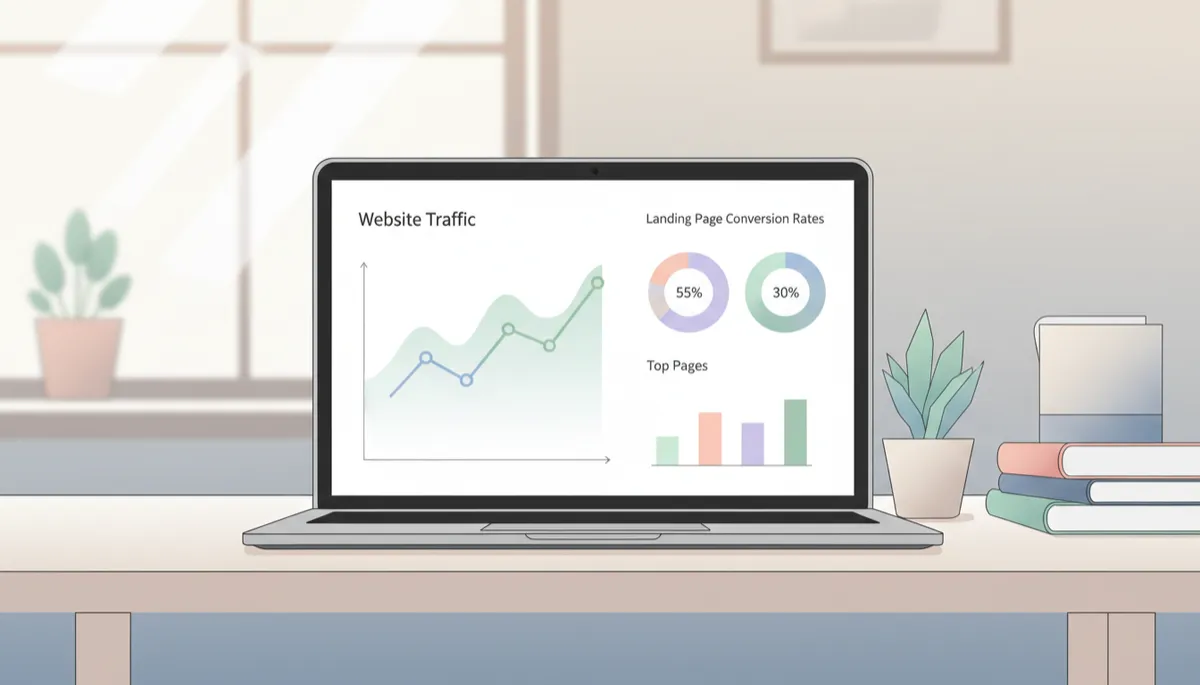
Focused landing pages often convert ad traffic into leads at much higher rates.
Websites vs. Landing Pages: Key Differences in Plain Language
Purpose: A website gives a full picture of your business; a landing page focuses on one specific offer or action.
Structure: A website has multiple pages and navigation; a landing page is usually a single page with minimal links to keep people focused.
Visibility: A website is built for long-term search visibility on Google and other search engines; a landing page is often tied to specific ads, emails, or campaigns.
Credibility: A website builds trust with detailed information, reviews, and local presence; a landing page leans on that trust to quickly capture leads or sales.
Benefits and Limitations of a Full Business Website
For most established small businesses in the Mid-Ohio Valley, a full website is essential. Its main benefits include:
Complete online presence: Customers can learn who you are, what you do, and how to reach you—without needing to call for every question.
Credibility and professionalism: A modern, well-organized site signals that you’re serious, established, and trustworthy—especially important for medical offices, law firms, and home service businesses entering people’s homes.
Long-term search visibility: When your site is structured correctly, you can show up for searches like “dentist in Vienna WV” or “HVAC repair Parkersburg” without paying for every click.
Room to grow: You can add blogs, FAQs, service areas, and resources over time to answer more questions and attract more traffic.
The limitations? A full website can be more complex and time-consuming to build and maintain. If it’s not designed with lead capture in mind—clear calls to action, easy forms, online booking—you might get visitors but not many inquiries. That’s where Smart Reception’s focus on websites that capture leads and connect to automation becomes valuable.
Benefits and Limitations of Landing Pages
Landing pages shine when you’re running targeted marketing. Their main benefits are:
High focus: One message, one offer, one action—no menu to click away, no distractions. This often leads to higher conversion rates from ads and email campaigns.
Easy to test and tweak: You can adjust headlines, images, and forms quickly to see what gets more people to respond.
Perfect for offers and promotions: Seasonal specials, new services, or limited-time deals can each have their own dedicated page.
The limitations are just as important to understand. A landing page by itself does not replace a full website. It usually doesn’t give the depth of information people expect when they’re researching a dentist, attorney, or contractor. It also doesn’t build long-term search visibility the way a full site can. Landing pages work best when they are connected to a broader online presence and follow-up system.
Real-World Examples: When to Use Each One
Here are some practical scenarios for small businesses in Parkersburg, Vienna, and the Mid-Ohio Valley:
When a Full Website Makes Sense
A local law firm wants to showcase different practice areas (family law, estate planning, criminal defense) and highlight attorney experience and case results. Prospects often research for days or weeks, so they need detailed information and trust signals.
A medical office in Vienna needs provider bios, insurance information, patient forms, and clear directions. Patients expect a complete, professional site before they book an appointment.
A home service contractor (HVAC, plumbing, electrical) serves multiple towns in the Mid-Ohio Valley and wants to rank in Google for “emergency plumber near me,” “AC repair Parkersburg,” and similar searches.
When a Landing Page Is the Better Tool
A salon is running a Facebook ad for “20% Off First Color Appointment This Month Only.” The ad clicks should go to a landing page focused only on that offer, with a simple form or online booking button.
An auto repair shop launches a Google Ads campaign for “brake repair Parkersburg.” Instead of sending visitors to the general home page, they send them to a landing page all about brake services, pricing, and a “Schedule Now” form.
A local gym offers a free 7-day pass. All email and social media promotions link to a landing page where people enter their name, phone, and email to claim the pass—feeding directly into an automated follow-up sequence.
Using Landing Pages Alongside Your Main Website
The most effective approach for many small businesses is not choosing one or the other, but using both together. Think of it this way:
Your main website is your online headquarters—where people learn about you, your services, and your reputation in the Mid-Ohio Valley.
Your landing pages are specialized entry doors for specific campaigns and offers—perfect for ads, email blasts, and social media promotions.
When these are connected to the right online systems—forms, appointment scheduling, CRM, and automated text or email follow-up—you don’t just get clicks. You get leads that are tracked, nurtured, and converted.
How Smart Reception Helps Turn Visitors into Customers
Smart Reception specializes in helping small businesses across Parkersburg, Vienna, and the Mid-Ohio Valley build professional websites and connected landing pages that do more than just look good. They’re designed to capture leads and never let opportunities slip through the cracks.
Here’s how Smart Reception ties everything together:
Lead-focused website design: Your main site clearly explains your services, showcases reviews, and makes it easy to call, text, or book online—on desktop and mobile.
High-converting landing pages: Each campaign—Google Ads, Facebook offers, email promotions—gets its own page with a clear call to action and simple form or scheduling link.
AI virtual receptionist and missed-call text back: If someone calls from your website or landing page and you can’t answer, Smart Reception can automatically text them back and keep the conversation going so you don’t lose the lead.
CRM and automation: Every form submission or landing page lead can flow into a simple CRM, with automated follow-up messages, appointment reminders, and review requests—without adding more to your plate.
📌 Key Takeaway: A website alone won’t maximize your marketing, and a landing page alone won’t build long-term credibility. Together—connected through Smart Reception’s automation—you get a system that turns traffic into booked appointments and paying customers.
Choosing Your Next Step
If you’re just starting out or your current site is outdated, your first priority should be a clean, credible business website that clearly explains who you are, what you do, and how to contact you. From there, you can layer in targeted landing pages for your most important services and promotions, especially when you’re investing in ads or email campaigns.
You don’t have to figure this out alone. Smart Reception helps small businesses in Parkersburg, Vienna, and the surrounding Mid-Ohio Valley build websites and online systems that are simple to use, professional, and designed from day one to capture leads and turn visitors into customers—without adding more manual work to your day.
If you’re ready to get clear on whether you need a new website, a landing page strategy, or both, schedule a free consultation today to discover how Smart Reception can help your business answer more calls, capture more leads, automate customer communication, and grow with confidence in the Mid-Ohio Valley and beyond.