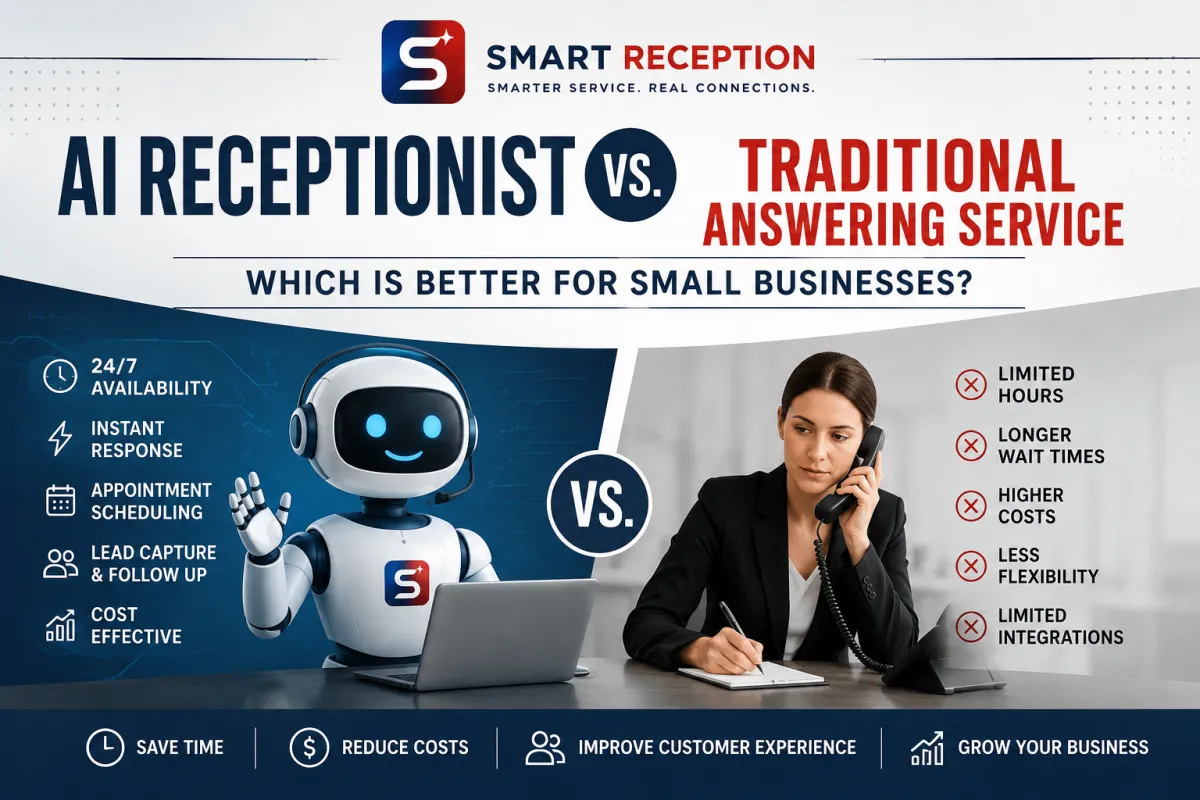
AI Receptionist vs. Traditional Answering Service: Which Is Better for Small Businesses?
AI Receptionist, Answering Service, Small Business Communication
AI Receptionist vs. Traditional Answering Service: Which Is Better for Your Business?
For small businesses, every missed call can mean a missed opportunity. Whether you run a home service company, medical office, law firm, auto repair shop, salon, or local professional practice, the way you answer the phone directly impacts revenue, reputation, and customer loyalty. Today, owners are increasingly choosing between an AI-powered receptionist and a traditional live answering service. Understanding the differences is essential before you invest.
AI Receptionist vs. Traditional Answering Service: A Quick Overview
An AI receptionist is a conversational, software-based assistant that answers calls, routes inquiries, books appointments, captures leads, and triggers automated workflows using artificial intelligence. Services like Smart Reception are designed specifically for small businesses and integrate deeply with calendars, CRMs, and marketing tools to create an end-to-end communication and automation system.
A traditional answering service relies on human operators who answer calls on your behalf, follow scripts, take messages, and sometimes schedule appointments. These services are typically billed per minute or per call and are widely used in medical, legal, and professional service environments where live interaction has historically been the norm.
Aspect AI Receptionist (e.g., Smart Reception) Traditional Answering Service Availability 24/7/365, unlimited concurrent callers 24/7 possible, but limited by agent capacity and staffing Typical Cost ~$99–$299/month flat for rich features and integrations ~$200–$400+/month for 50–100 minutes, plus overages and fees Speed & Response Instant pickup, no hold times, consistent scripts Variable wait times; quality can depend on agent and call volume Appointment Scheduling & Automation Direct calendar booking, CRM updates, automated reminders, workflows Manual entry; limited automation and integrations Scalability Scales instantly with call volume at predictable cost Requires more agents; higher minutes = higher bill
1. Availability: Who Really Answers Every Call?
Customers now expect immediate responses, regardless of time or day. Research on answering services shows that many small businesses previously relied on voicemail after hours, leading to lost leads and frustrated callers. AI receptionists directly address this gap by providing round-the-clock availability without additional staffing costs.
AI Receptionist: Always on—24/7/365, including nights, weekends, and holidays. It can handle multiple callers at once, so no one hears a busy signal or is left on hold.
Traditional Answering Service: Often offers 24/7 coverage, but availability depends on human staffing levels. During peak times, callers may wait, be placed on hold, or experience rushed interactions.
For a solo contractor or small medical office, this difference is critical. An AI receptionist from Smart Reception can automatically answer the late-night emergency plumbing call or the early-morning patient inquiry with the same professionalism as during business hours—without overtime or shift scheduling.
2. Cost: What Do You Really Pay Each Month?
Cost is often the deciding factor for small businesses. Traditional live answering services typically charge per minute or per call. According to industry comparisons, plans commonly start around $200–$400 per month for just 50–100 minutes of talk time, with additional per-minute rates, setup fees, and even holiday surcharges. As call volume grows, the bill can quickly become unpredictable and difficult to budget.
Modern AI receptionist solutions, by contrast, offer flat-rate pricing. Research across providers in 2026 shows that robust AI receptionist plans with full features and integrations commonly range from about $99 to $299 per month, with many small businesses finding the best value around $149–$199. For that price, you typically get unlimited calls, CRM and calendar integrations, and automation capabilities that human services simply cannot match at the same cost level.
Scenario (Per Month) AI Receptionist (Flat-Rate) Traditional Answering Service (Per-Minute) 100 calls, 3 min each (300 min) ~$149–$199, unlimited calls ~$318–$525 at $1.06–$1.75/min plus fees 250 calls, 2 min each (500 min) Same flat rate, predictable bill ~$530–$875+, depending on plan and overages
When you compare these numbers to the fully loaded cost of hiring an in-house receptionist—often $3,700–$5,000 per month with salary, benefits, and overhead—the savings of AI become even more apparent. For most small and growing businesses, AI receptionists deliver enterprise-level capabilities at a fraction of the traditional cost.
3. Speed: How Fast Does Each Caller Get Help?
Speed matters. Callers are far more likely to hang up if they are placed on hold or sent to voicemail. AI receptionists excel at instant response. As soon as the phone rings, the AI answers with a consistent, branded greeting and begins helping the caller—no ringing through multiple lines, no queue, no delay.
AI Receptionist: Answers on the first ring, every time. Handles common questions, routes calls, and books appointments in seconds. It can also send immediate follow-up texts or emails summarizing the call.
Traditional Answering Service: Response time depends on how many agents are available and how many callers are in the queue. During busy periods, callers may be put on hold, transferred, or asked to repeat information multiple times.
For a local HVAC company during a heat wave, for example, dozens of calls can arrive in a short window. An AI receptionist from Smart Reception can handle them concurrently, capture every lead, and prioritize emergencies without forcing anyone to wait on hold or leave a voicemail.
4. Customer Experience: Human Touch vs. Consistent Professionalism
Many owners worry that AI will feel cold or robotic. In reality, modern conversational AI has advanced significantly. With natural-sounding voices, smart routing, and context awareness, an AI receptionist can deliver a polished, consistent experience that reflects your brand values—“prompt, professional, and respectful of every customer’s time.”
Benefits of AI for customer experience:
No rushed or distracted agents—tone and language are always on-brand.
Ability to remember context across channels, such as previous calls or recent text conversations.
Immediate follow-up via SMS or email, reinforcing professionalism and reliability.
Benefits of human answering services:
Empathetic handling of highly sensitive situations, such as complex legal or medical conversations.
Ability to deviate from scripts in nuanced, one-off scenarios—though this can also introduce inconsistency.
Consistent, instant responses reassure callers that your business is attentive and reliable.
For most routine inquiries—“What are your hours?”, “Do you have availability tomorrow?”, “Can I get a quote?”—AI delivers a smoother, faster experience than a traditional answering service. For highly complex or emotionally charged calls, a hybrid model that blends AI with human backup can provide the best of both worlds.
5. Appointment Scheduling: From Phone Tag to Automated Booking
Missed calls often turn into missed appointments. Traditional answering services may take a message or, in some cases, log into your scheduling system manually. This introduces delay and the risk of double-booking or data entry errors. In contrast, an AI receptionist can connect directly to your calendar and book in real time.
Check real-time availability across one or more team calendars.
Offer specific time slots to callers and confirm appointments on the spot.
Trigger automated reminders via SMS and email, reducing no-shows.
Imagine a salon owner who receives a call at 10 p.m. from a new client looking for a Saturday appointment. With Smart Reception, the AI can see openings, book the service, send a confirmation text, and update your calendar automatically—no phone tag, no manual data entry, and no lost opportunity.
6. Lead Capture: Turning Every Call into a Sales Opportunity
A major advantage of AI receptionists is their ability to capture and organize detailed lead information automatically. While a traditional answering service can take a name and phone number, AI can go further:
Ask structured qualifying questions (budget, service type, timeline, location).
Score or tag leads in your CRM based on their responses.
Trigger automated follow-up sequences—such as a “thank you” text, a quote request form, or a link to book a consultation.
Industry data shows that AI-based answering can dramatically improve after-hours lead capture, particularly for solo operators who previously relied on voicemail. When every inquiry is logged in your CRM and followed up automatically, your marketing dollars go further and your close rate improves.
7. Scalability: Can Your System Grow with Your Business?
Growth is good—but it can strain traditional answering services. As call volumes increase, human-based services must add more agents, which raises costs and can still leave callers waiting. AI receptionists, however, are inherently scalable. They can handle many calls at once without sacrificing quality or speed.
Seasonal spikes (tax season for accountants, holidays for retailers, summer for HVAC) are absorbed without renegotiating contracts or paying surge rates.
New locations or service lines can be added simply by updating scripts, routing rules, and automations—no hiring or training cycles required.
For a growing multi-location auto repair chain, for example, Smart Reception can centralize call handling for all shops, route callers to the correct branch, and maintain consistent standards across the brand—while your monthly cost remains predictable and manageable.
8. Business Automation: Beyond Answering the Phone
The most significant difference between AI receptionists and traditional answering services lies in automation. In 2026, business automation is no longer a luxury—it is a strategic necessity. Reports show that nearly all organizations view automation as essential to their technology stack, and many are redesigning workflows around AI to reduce manual tasks and improve ROI.
Smart Reception is built around this reality. Instead of simply taking messages, the AI receptionist becomes a hub for your customer communication and operations:
CRM Automation: Every call, text, and form submission is automatically logged in your CRM. New contacts are created with complete details, and existing records are updated without manual data entry.
Missed-Call Text Back: If someone hangs up before the AI can help—or if a direct line goes unanswered—an automated text can follow up within seconds, inviting the caller to reply or schedule online.
Review Management: After a successful appointment, the system can automatically send a review request via SMS or email, helping you build your online reputation with minimal effort.
Marketing Automation: New leads can be added to drip campaigns, promotional text lists, or nurture sequences—keeping your business top of mind without manual follow-up.
Traditional answering services, by contrast, are primarily focused on live call handling. While some may offer basic integrations or message delivery via email or text, they rarely provide the level of end-to-end automation, analytics, and workflow orchestration that AI-powered platforms now make possible.
Practical Examples: How Different Businesses Benefit
Example 1: Home Service Contractor
A small plumbing company used a traditional answering service to handle after-hours calls. During a busy winter season, they noticed rising monthly bills due to long calls and high call volume, yet they still received complaints about slow responses and missed callbacks. After switching to Smart Reception, the owner gained:
24/7 instant pickup for emergency calls, with automated escalation to on-call technicians.
Flat-rate pricing that remained stable, even as marketing campaigns increased call volume.
Automatic logging of every inquiry into the CRM, with follow-up texts sent to unbooked leads.
Example 2: Medical Practice
A small medical office needed empathetic handling for complex clinical questions but was overwhelmed by routine calls about hours, directions, and appointment changes. They adopted a hybrid approach: Smart Reception handles routine inquiries, appointment booking, and reminders, while staff manage sensitive conversations and in-depth medical questions. The result:
Front-desk staff spend more time on in-person care and less time on repetitive phone calls.
Patients experience faster responses and fewer busy signals when calling to confirm or reschedule.
No-shows decline due to automated reminder sequences triggered directly from booked appointments.
Example 3: Law Firm
A small law firm previously relied on a premium human answering service to ensure a “high-touch” first impression. However, they struggled with inconsistent intake quality and incomplete information. After moving to Smart Reception and customizing their intake flows, they achieved:
Standardized, thorough intake for every potential client, including case type, urgency, and key facts.
Automatic routing of high-value leads to partners, with instant notifications and calendar invites.
Reduced monthly communication costs, despite an increase in lead volume.
Which Option Is Better for Your Business?
Both AI receptionists and traditional answering services can help you avoid missed calls and improve responsiveness. The right choice depends on your priorities:
Choose a traditional answering service if your calls are highly sensitive, low in volume, and require frequent, nuanced human judgment that cannot be standardized or automated.
Choose an AI receptionist if you want predictable costs, 24/7 availability, fast response times, robust lead capture, integrated appointment scheduling, and business automation that goes far beyond message taking.
For most small businesses—especially those looking to grow efficiently—AI receptionists now offer the strongest combination of affordability, scalability, and operational impact. When paired with thoughtful workflows and, where appropriate, human backup, AI becomes a powerful digital coworker that helps you deliver better service with less effort.
Take the Next Step with Smart Reception
If you are tired of missed calls, inconsistent customer experiences, and manual follow-up, now is the time to explore what an AI receptionist can do for your business. Smart Reception is built specifically for small businesses and local service providers, combining AI-powered phone answering, appointment scheduling, CRM automation, missed-call text back, review management, and SMS/email marketing into one simple, affordable solution.
Our mission is straightforward: help you never miss another opportunity while making modern technology easy to use and aligned with your day-to-day reality. Whether you run a single-location shop or a growing multi-location operation, we can tailor Smart Reception to fit your workflows, tools, and growth goals.
Schedule a free consultation today to discover how Smart Reception can help your business answer more calls, capture more leads, automate customer communication, and grow with confidence.