How Much Does an AI Receptionist Cost? A Complete Pricing Guide for Small Businesses
AI Receptionists, Small Business, Pricing Guide
How Much Does an AI Receptionist Cost? A Complete Pricing Guide for Small Businesses
If you are a small business owner, you have probably wondered whether an AI receptionist could finally help you stop missing calls without taking on the cost of another full-time employee. This guide breaks down what AI receptionists cost in 2026, how different pricing models work, what you get at each price point, and how AI compares to hiring a traditional receptionist or using a live answering service.
Why Small Businesses Are Switching to AI Receptionists
Phone calls are still one of the most valuable sources of new business. Yet many small businesses struggle to answer every call, especially after hours or during busy periods. Missed calls often mean missed revenue, poor customer experience, and negative reviews. At the same time, hiring a full-time receptionist or paying for a premium live answering service can be difficult to justify financially.
Modern AI receptionists offer a middle ground: 24/7 phone answering, call routing, appointment scheduling, and follow-up messages at a fraction of the cost of human-only solutions. According to recent industry analyses, AI receptionist plans typically range from around $20 to $300 per month, while a fully loaded in-house receptionist can cost $51,000 to $70,000 per year in the U.S. when salary, benefits, and overhead are included (getnextphone.com, voksha.com). That cost gap is the main reason AI is gaining traction with small businesses across industries—from home services and medical practices to law firms and salons.
Common Pricing Models for AI Receptionists
While every provider structures pricing a little differently, most AI receptionist plans fit into a few standard models. Understanding these models will help you compare options and avoid surprise bills.
1. Entry-Level, Usage-Capped Plans ($20–$65/month)
Entry-level AI receptionist plans are designed for solo operators and very small teams with light call volume. Many providers in this tier charge between $20 and $65 per month and include a modest number of calls or minutes. For example, some services include around 30–60 calls or minutes and then charge overage fees per extra call (getaira.io, mapleconnect.ai, trtc.io).
Best for: freelancers, consultants, small home service businesses, or new practices just starting out.
Typical features: basic call answering, simple call routing, voicemail transcription, and canned responses to common questions.
2. Mid-Range, Feature-Rich Plans ($59–$150/month)
Mid-range plans usually cost between $59 and $150 per month and are built for growing small businesses that need more minutes, more flexibility, and better integrations. These plans often include 100–300 calls or minutes and may still charge overage fees, but the included usage is more realistic for a busy local business (dialphone.com, mapleconnect.ai, getaira.io).
Best for: established small businesses with steady call volume, such as clinics, salons, or multi-tech service companies.
Typical features: appointment scheduling, calendar sync, basic CRM integration, call summaries, and simple workflows like routing emergencies to on-call staff.
3. Flat-Rate Unlimited AI Plans ($149–$299/month)
Flat-rate unlimited plans are especially attractive to small businesses that want predictable monthly costs and do not want to worry about minutes or per-call charges. These plans usually fall in the $149 to $299 per month range and include unlimited inbound calls, 24/7 coverage, and a full suite of features (getnextphone.com).
Best for: small businesses with moderate to high call volume, or those that experience seasonal spikes and want cost stability.
Typical features: everything from mid-range plans plus advanced routing, spam filtering, multi-location support, and more robust reporting.
4. Hybrid AI + Human and Premium Plans ($255–$1,275+/month)
Some providers combine AI with live human operators for complex calls or overflow. These hybrid or premium plans typically start around $255 per month for a small number of calls and can exceed $1,000 per month as volume increases (getnextphone.com, dialphone.com). They are generally aimed at firms that require human backup for sensitive or high-value conversations, such as law offices or medical specialists.
5. Enterprise-Level AI Receptionist Plans ($497–$1,997+/month)
At the top end, some enterprise AI receptionist platforms charge $497 to nearly $2,000 per month, often with additional setup fees, for large organizations with multi-location, high-volume, or highly regulated requirements (wildrunai.com). While these are usually beyond what most small businesses need, they illustrate the scalability of AI receptionist technology.
Key Factors That Affect AI Receptionist Pricing
When you compare plans, look beyond the headline price. Several underlying factors can significantly affect your real monthly cost and the value you receive.
Pricing structure (per minute, per call, or flat-rate) – Per-minute and per-call plans can look inexpensive initially but become unpredictable as call volume grows. Flat-rate unlimited options are often more stable for busy businesses (getaira.io, getnextphone.com).
Included usage and overages – How many calls or minutes are included? What happens when you go over? Overage fees of even $0.75–$1.40 per minute can add up quickly at higher volumes (dialphone.com, oncallclerk.com).
Feature set – Some providers lock essential tools such as appointment booking, CRM integration, or multi-language support behind higher tiers. A cheaper plan without the features you need can cost you more in lost productivity and missed opportunities.
Compliance and security – If you operate in healthcare, legal, or financial services, you may require HIPAA-compliant or industry-specific security features. These can influence pricing but are critical for risk management (dialphone.com, techradar.com).
Setup and onboarding costs – Some enterprise plans charge one-time setup fees that range from $1,500 to $3,000 (wildrunai.com). For small businesses, these fees can be a major consideration.
💡 Practical tip: Before choosing a plan, estimate your average monthly call volume and peak seasons. Then run the numbers for at least three months of usage, including overages, to see which pricing model truly fits your business.
What You Get at Different AI Receptionist Price Points
While every platform is different, there are common patterns in what features you can expect as you move from entry-level to premium AI receptionist plans. Below is a general overview tailored to typical small business needs.
Under $50/month: Basic Coverage and Call Capture
Simple call answering with your business greeting and hours.
Basic FAQs, such as location, services, and pricing ranges.
Voicemail transcription and email notifications.
This tier is primarily about ensuring that someone—or something—always answers the phone and takes a message, even outside office hours. It reduces missed calls but may not fully automate your front desk.
$59–$150/month: Appointment Scheduling and Integrations
Two-way calendar sync with tools like Google Calendar or Outlook to book and manage appointments in real time.
CRM integration to automatically create or update contact records and log calls.
More advanced call flows, such as routing new leads to sales and existing clients to support, or escalating emergencies to on-call staff.
At this level, your AI receptionist starts to function like a true digital team member, not just an answering machine. It can reserve appointments, qualify leads, and keep your systems updated without manual data entry.
$149–$299/month: 24/7, High-Volume, Fully Automated Front Desk
24/7 call handling with unlimited or very high usage limits, ideal for busy offices and multi-location businesses.
Multi-language support, advanced natural language understanding, and sentiment-aware responses for more natural conversations (forbes.com, businessinsider.com).
Deeper automation, including missed-call text back, follow-up messages, review requests, and integrated marketing workflows.
For many small businesses, this tier delivers the best balance of cost, coverage, and capability—especially when combined with CRM automation and marketing tools like those provided by Smart Reception.
AI Receptionist vs. Full-Time Receptionist vs. Traditional Answering Service
To truly understand value, it helps to compare the total cost and coverage of AI receptionists against the two most common alternatives: hiring an in-house receptionist or outsourcing to a live answering service.
Option Typical Monthly Cost Typical Annual Cost Coverage & Notes In-house receptionist (full-time) $4,300–$5,800 $51,000–$70,000+ 40 hours/week, limited after-hours; includes salary, benefits, taxes, and overhead (getnextphone.com, voksha.com). Live virtual receptionist / answering service $200–$800+ $2,400–$9,600+ Often per-minute plans with caps and overages; some 24/7 coverage but costs rise with volume (oncallclerk.com, getnextphone.com). Entry-level AI receptionist $20–$65 $240–$780 Limited calls or minutes; basic call answering and message taking (mapleconnect.ai, trtc.io). Mid-tier AI receptionist $59–$150 $708–$1,800 More calls/minutes plus scheduling and integrations; some overages possible (voksha.com). Flat-rate unlimited AI receptionist $149–$299 $1,788–$3,588 Unlimited calls, 24/7 coverage, advanced automation; highly predictable billing (getnextphone.com, oncallclerk.com).
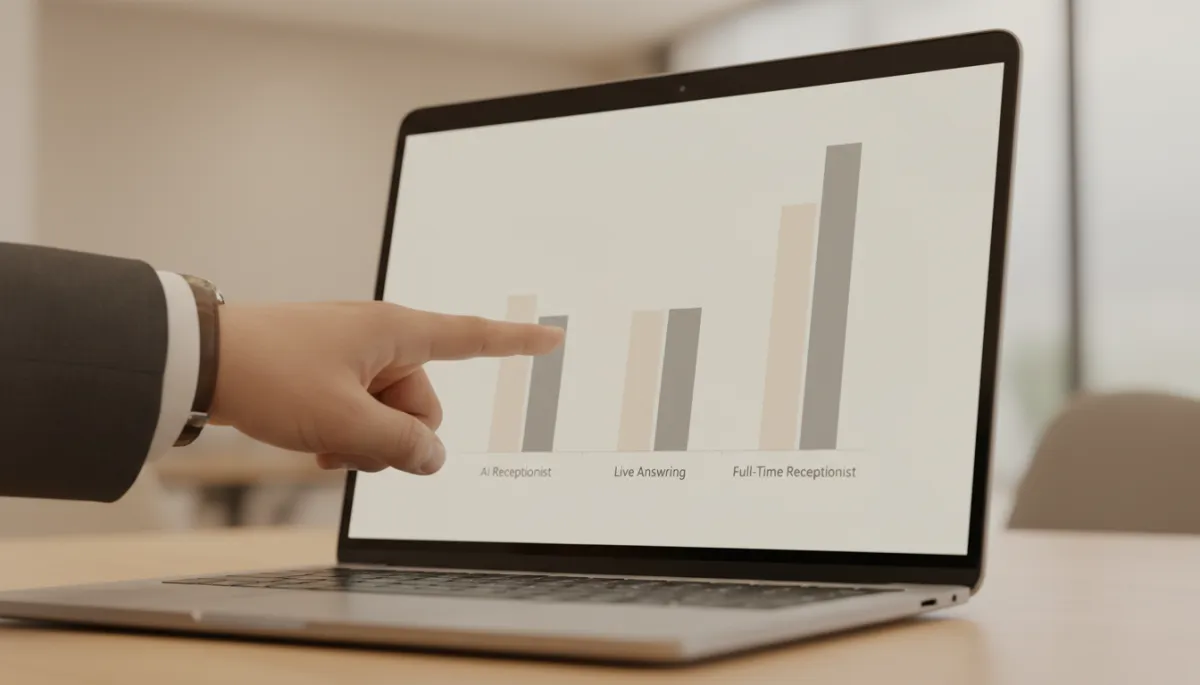
Many small businesses save thousands per month by moving from human-only reception to AI.
Practical Examples: What Different Businesses Actually Pay
Consider a small plumbing company receiving around 200 calls per month. A human answering service charging by the minute might cost $400–$700 monthly, especially if calls are longer or if there are frequent after-hours emergencies. A flat-rate AI receptionist plan at around $199–$249 per month could handle all those calls 24/7, book jobs directly into a scheduling system, and send automated follow-up texts—often at less than half the cost of the human service.
Now imagine a growing medical practice that previously employed a full-time receptionist at a total cost of about $4,800 per month. By shifting routine phone tasks—such as appointment reminders, insurance FAQs, and new patient intake—to an AI receptionist in the $150–$300 range, they can reassign the human receptionist to in-clinic care coordination and billing support, significantly improving efficiency without adding headcount.
How to Choose the Right AI Receptionist Solution for Your Business
Selecting the right AI receptionist is not just about picking the cheapest plan. It is about aligning coverage, features, and pricing with your specific workflows and growth goals. Here are some practical steps to guide your decision.
Clarify your call volume and patterns. Review at least three months of call logs if possible. Note average calls per day, peak times, and after-hours activity. This will help you decide whether a capped or unlimited plan makes more sense.
List your must-have features. For many small businesses, essentials include appointment booking, missed-call text back, CRM integration, and review-request automation. If a low-priced plan does not include these, your team will still spend time on manual tasks.
Consider your industry and compliance needs. Medical offices, law firms, and financial professionals may require specific security, consent, and data-handling capabilities. Confirm that any AI solution you consider can meet those requirements.
Evaluate total cost of ownership. Factor in setup, potential overages, training time, and any add-ons you might need. An all-in-one platform that includes AI receptionist, CRM automation, and marketing tools may be more cost-effective than piecing together multiple subscriptions.
Test real-world performance. Whenever possible, use a free trial or pilot period. Check call quality, accuracy, and how well the AI reflects your brand voice. Ask your staff and customers for feedback on the experience.
📌 Key takeaway: The “best” AI receptionist is the one that reliably answers every call, books more business, reduces manual work for your team, and fits comfortably within your monthly budget.
How Smart Reception Helps Small Businesses Maximize Value
Smart Reception is built specifically for small businesses that want enterprise-level communication and automation without enterprise-level complexity or cost. Beyond AI-powered call answering, Smart Reception can connect your phone system to your CRM, appointment calendar, review platforms, and marketing tools to create a seamless customer journey—from first call to repeat business and referrals.
AI receptionist that answers calls 24/7, captures leads, and routes urgent issues appropriately.
Automated appointment scheduling and reminders to reduce no-shows and back-and-forth phone tag.
Missed-call text back, SMS and email follow-ups, and review management to improve customer satisfaction and online reputation.
CRM automation and marketing workflows that nurture leads and keep your pipeline full without extra admin work.
By combining AI receptionist capabilities with broader automation, Smart Reception helps you not only answer more calls but also convert more of those calls into booked appointments, loyal customers, and positive reviews—while keeping your monthly costs predictable and manageable.
Final Thoughts and Next Steps
In 2026, AI receptionists offer small businesses a powerful way to deliver prompt, professional responses to every caller without taking on the high fixed costs of a full-time receptionist or the unpredictable bills of traditional answering services. With entry-level plans starting around $20–$65 per month and robust flat-rate options in the $149–$299 range, most local businesses can find a solution that dramatically improves responsiveness and customer experience while still fitting their budget.
The key is to choose a partner that understands small business realities: limited time, limited staff, and the need to make every call count. That is where Smart Reception comes in. Our mission is simple—to make sure you never miss another opportunity and to replace manual processes, outdated tools, and fragmented communication with a streamlined, automated system that just works.
If you are ready to explore whether an AI receptionist is right for your business, you do not need to make the decision alone. Smart Reception can help you review your current call volume, identify where you are losing opportunities, and map out a practical, cost-effective plan tailored to your industry and growth goals.
Schedule a free consultation with Smart Reception today to discover how AI-powered phone answering, customer communication, and automation can help your business answer more calls, capture more leads, and grow with confidence—without adding unnecessary complexity or overhead.